

eth_subscribe,
your application can receive real-time notifications of transaction hashes as they enter the transaction pool (mempool). This push-based approach helps build responsive decentralized applications,
monitor network activity, and provide transaction tracking or analytics in near real-time.
In this guide, we focus on subscribing to pending transactions using eth_subscribe. The provided boilerplate uses a WebSocket provider (pointing to wss://quicknode.peaq.xyz),
creates a subscription for pending transactions, handles incoming data and errors, and includes a graceful shutdown routine to properly clean up the subscription and disconnect the WebSocket provider.
Prerequisites
- Node.js Environment: You have Node.js installed on your system.
- Familiarity with JavaScript: You are comfortable with JavaScript and asynchronous programming (using async/await).
- WebSocket Connection: You will connect to a peaq network node via WebSocket (using
wss://quicknode.peaq.xyz). - Dependencies: The required packages (
web3,dotenv, andweb3-providers-ws) are installed. - Basic Blockchain Knowledge: You understand the concepts of pending transactions, mempool, and real‑time event subscription.
Instructions
1. Setting Up the Environment
- Install Dependencies: Ensure you install the necessary packages:
- Set ESM Module:
Add the following to your
package.jsonto allow for ESM modules.
- Configure Environment Variables:
Create a
.envfile with the following content:
2. Understanding eth_subscribe
The eth_subscribe method is a JSON-RPC method available over WebSocket connections. It allows you to subscribe to various types of events on the blockchain in real-time. When subscribing to pending transactions,
the node sends updates as soon as new transactions are detected in the mempool. Here’s how it works:
-
Subscription Request:
When you call
web3.eth.subscribe('pendingTransactions'), the node sets up a listener for new pending transactions. -
Data Event:
The subscription object returns a push-based stream of events. Each event provides the transaction hash of a pending transaction. The code attaches an event handler on the
"data"event to process each incoming transaction hash. -
Error Handling:
An
"error"event is also attached to handle any issues (e.g., network errors or connection drops).
3. Implementing the Boilerplate
The provided boilerplate performs the following steps:-
Initialize the Provider and Web3 Instance:
A WebSocket provider is created using
web3-providers-ws, connecting to the peaq network RPC endpoint. -
Subscribe to Pending Transactions:
An asynchronous function is used to call
web3.eth.subscribe('pendingTransactions'). Once the subscription is created, event handlers for"data"and"error"are attached. -
Graceful Shutdown:
A signal handler for
SIGINT(e.g., when pressing Ctrl+C) is registered. Upon receiving the shutdown signal, the code unsubscribes from pending transactions and disconnects the WebSocket provider to ensure a clean exit.
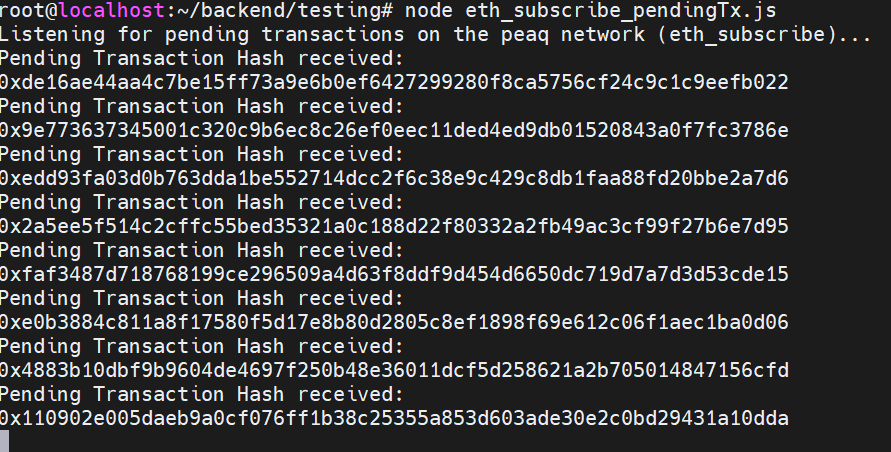
Conclusion
This guide demonstrates how to use theeth_subscribe JSON-RPC method to listen to pending transactions on peaq network.
Using this approach, your application can efficiently monitor the mempool for new pending transactions, enabling you to build responsive, data-driven decentralized applications on the peaq network.
Feel free to customize and extend the boilerplate code to suit your specific requirements.